
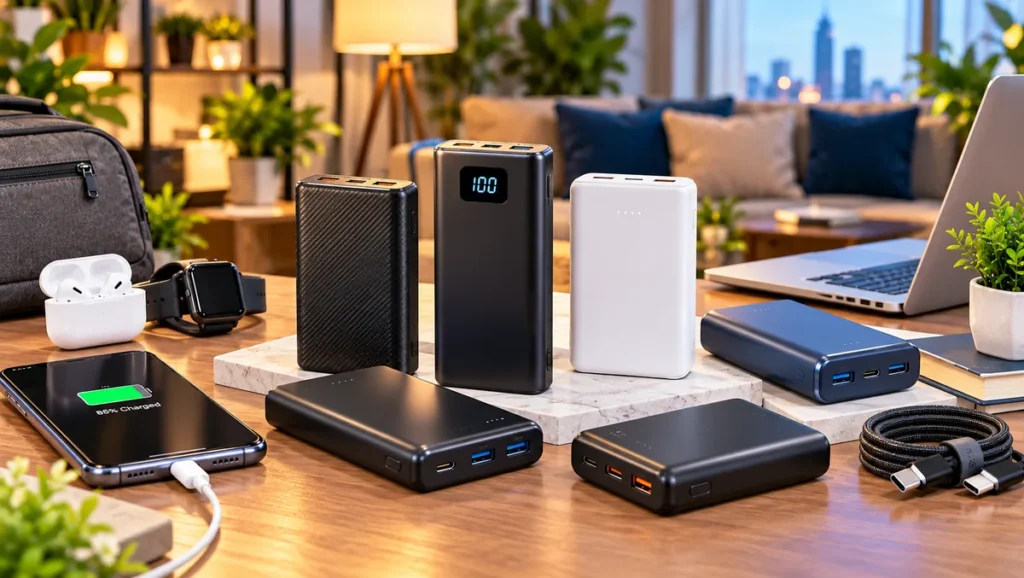
A smartphone has become an essential part of everyday life. We use our phones for communication, online payments, navigation, entertainment, work and much more. But all these activities can drain the battery quickly, especially when you are travelling or spending a long day away from a power outlet.
A power bank can be a simple solution to this problem. However, with so many models available in different capacities, sizes, charging speeds and price ranges, choosing the right one can sometimes be confusing.
In this guide, we explain how to choose the best power banks for everyday use and what features you should check before buying one.
What Is a Power Bank?
A power bank is a portable battery that stores electrical energy and allows you to charge devices such as smartphones, wireless earbuds, smartwatches and other USB-powered gadgets when you don’t have access to a wall charger.
Power banks are available in different capacities. Smaller models are easy to carry, while higher-capacity models can provide multiple charges for smartphones and can be useful for travel or long working days.
Why Should You Buy a Power Bank?
There are several situations where a power bank can be extremely useful.
1. Travel
Long journeys may not always provide convenient access to charging points. A power bank can help keep your phone charged while travelling by bus, train, car or airplane.
2. Outdoor Activities
If you spend time outdoors, hiking, camping or attending events, a portable charger can provide additional battery backup.
3. Emergency Backup
A charged power bank can be useful during unexpected power cuts or emergencies when your smartphone needs to remain available.
4. Work and Study
People who use smartphones heavily for work, online meetings, communication or study can benefit from having an additional power source nearby.
How to Choose the Best Power Bank
Before buying a power bank, don’t look only at its capacity or price. Consider the following features.
1. Battery Capacity
Capacity is normally measured in mAh (milliamp-hours).
Common capacities include:
- 5,000mAh
- 10,000mAh
- 20,000mAh
- 25,000mAh and above
A 5,000mAh power bank is generally compact and suitable for basic emergency charging.
A 10,000mAh power bank offers a good balance between portability and battery backup for everyday smartphone users.
A 20,000mAh power bank can be more suitable for frequent travellers, heavy smartphone users or people who need several charging cycles.
Remember that the actual usable output is lower than the advertised battery capacity because of conversion and charging losses.
2. Charging Speed
Charging speed is another important factor.
Look for specifications such as:
- USB-C Power Delivery
- Fast charging
- PD charging
- Quick charging compatibility
- Higher wattage output
If your smartphone supports fast charging, choose a power bank that supports a compatible charging standard. Otherwise, you may not get the charging speed you expect.
3. USB-C Port
USB-C has become increasingly common across modern smartphones, tablets and other electronics.
A power bank with USB-C input and output can be more convenient because the same type of cable may be used for charging the power bank and connected devices.
4. Number of Ports
Think about how many devices you normally carry.
If you only charge your smartphone, one or two outputs may be enough.
If you regularly carry a smartphone, earbuds, smartwatch or another device, a power bank with multiple ports can be more convenient.
However, charging several devices simultaneously may divide the available power between the ports, depending on the model.
5. Size and Weight
Higher capacity usually means a larger and heavier power bank.
For daily use, a 10,000mAh model can be a practical middle ground for many people.
For travel, you may prefer higher capacity, but make sure the additional weight is acceptable for your bag.
6. Safety Features
Safety should be one of the most important considerations.
Look for reputable products with appropriate protection features such as:
- Overcharge protection
- Over-discharge protection
- Short-circuit protection
- Over-temperature protection
- Over-voltage protection
Buying from a reputable manufacturer and seller is also important.
7. Digital Battery Display
Some power banks include a small digital display showing the remaining battery percentage.
This can be more convenient than a simple row of LED indicators because you can see approximately how much charge remains.
10,000mAh vs 20,000mAh Power Bank
| Feature | 10,000mAh | 20,000mAh |
|---|---|---|
| Portability | Excellent | Moderate |
| Weight | Lower | Higher |
| Backup | Good | Very Good |
| Travel | Good | Excellent for longer trips |
| Everyday use | Excellent | Good |
| Multiple devices | Moderate | Better |
| Bag space | Less | More |
For everyday smartphone users, 10,000mAh is often a practical choice. If you frequently travel or need to charge multiple devices, a 20,000mAh model may be more suitable.
Important Features for Travelers
If you are buying a power bank specifically for travel, consider more than just capacity.
Choose a model that is:
- Compact enough for your bag
- Lightweight
- Equipped with USB-C
- Capable of fast charging
- Made by a reputable brand
- Clearly labelled with its electrical specifications
Also, check your airline’s current rules before flying with a power bank, because restrictions can apply to lithium-battery devices, especially regarding capacity and where they may be carried.
Common Mistakes to Avoid
Choosing Only by Price
The cheapest best power banks isn’t necessarily the best value. Build quality, charging performance and safety features matter too.
Buying an Unknown Brand
Extremely cheap products with unclear specifications can be a poor choice for expensive electronics.
Ignoring Charging Standards
A high-capacity power bank may still charge your phone slowly if its output doesn’t support the required charging standard.
Buying More Capacity Than You Need
A 20,000mAh model isn’t always better than a 10,000mAh model. If portability is your priority, the smaller option may be more practical.
Forgetting the Cable
Your best power banks may support fast charging, but the cable also needs to support the required charging standard.
Which Power Bank Should You Choose?
Your ideal choice depends on how you plan to use it.
For everyday smartphone use:
Choose a compact 10,000mAh power bank with USB-C and fast charging support.
For frequent travel:
Consider a 20,000mAh model with multiple outputs and fast charging.
For emergency backup:
A smaller 5,000mAh or 10,000mAh model can be convenient because it is easy to keep in a handbag, backpack or car.
For multiple devices:
Look for higher capacity, multiple ports and sufficient output power.
Final Thoughts
The best power banks are not necessarily the biggest or most expensive models. The right choice depends on your devices, charging requirements, travel habits and preferred portability.
For most users, a reliable 10,000mAh USB-C power bank with fast charging and built-in safety protections can provide a good balance between convenience and performance.
Before purchasing, compare capacity, charging speed, ports, size, safety features, warranty and seller reputation. This simple checklist can help you choose a power bank that is practical for everyday use and provides dependable backup when you need it.
Affiliate Disclosure
Some links on TruCoreHub may be affiliate links. If you purchase a product through an affiliate link, we may earn a small commission at no additional cost to you. Our recommendations are intended to help readers make informed purchasing decisions.